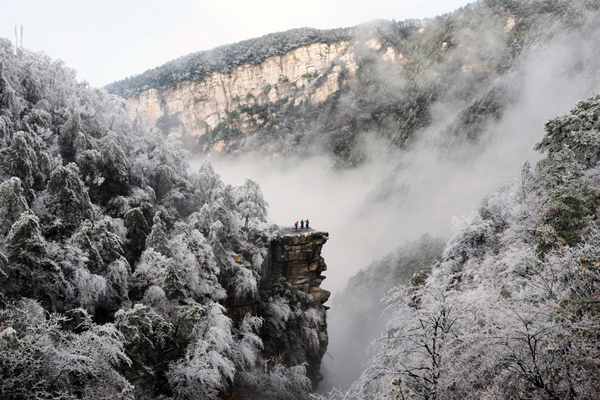
Lushan National Park
Introduction
Lushan National Park, located in the northern part of Jiangxi province, China, is one of the country's most famous and historically significant mountainous regions. It covers an area of 30,200 hectares and is home to more than 90 peaks, the tallest being Hanyang Peak at an elevation of 1,474 meters. This region is not only renowned for its breathtaking natural beauty but also for its rich cultural heritage and historical significance. Lushan Mountain serves as the birthplace of Chinese landscape poetry, and its scenic beauty has inspired countless poets and artists over the centuries. The park's unique blend of natural landscapes and cultural landmarks earned it a place on the UNESCO World Heritage List in December 1996 as a cultural site. Additionally, the park is recognized as a UNESCO Global Geopark.
Lushan National Park is a leisure paradise that attracts millions of visitors annually, drawn to its stunning waterfalls, brooks, shifting mists, and fogs, along with remarkable quaternary glaciation remains.
History
Lushan National Park boasts a rich and varied history that spans over 2,000 years, with its natural beauty and strategic location near the Yangtze River and Poyang Lake attracting spiritual leaders, scholars, artists, and writers through the ages. The mountain has more than 200 historic buildings and complexes, many of which are significant cultural and religious sites. These include the Buddhist East Grove Temple complex, founded by Huiyuan in 386 CE. The Temple of Simplicity and Tranquility, a repository of Taoist scriptures, and the White Deer Cave Academy, built in 940 CE and later revived in the 12th century during the Song Dynasty (960-1279) by Zhu Xi, are also noteworthy historical sites.
The White Deer Cave Academy is especially significant as one of the four famous Confucius academies of ancient China. It played a crucial role in the spread of Confucian political and ethical teachings, contributing to the cultural development of the region. The academy, along with many other temples, study halls, and libraries, continued to expand up to the 19th century.
During the late 19th and early 20th centuries, Lushan became a popular resort area, and around 600 villas were constructed by Chinese and foreign visitors. These villas reflect various architectural styles and are laid out according to Western planning concepts. This era marked the integration of Chinese and Western cultures, making Lushan a focal point for cultural exchange.
Geography and Biodiversity
Lushan National Park is characterized by its diverse and dramatic geographical features. The mountain range stretches over 302 square kilometers, with prominent peaks, deep valleys, and lush forests. The park's location between the Yangtze River to the north and Poyang Lake to the south creates an integral landscape of rivers, hills, and lakes, contributing to its stunning visual appeal. The area is known for its quaternary glaciation remains, which are rare and valuable for scientific study, offering insight into the Earth's historical climatic conditions.
The park's unique topography supports a rich array of biodiversity, with a variety of plant and animal species inhabiting its forests and waters. The shifting mists and fogs that envelop the mountain add to its mystical atmosphere and help sustain its diverse ecosystems. The natural beauty of Lushan is complemented by its cultural elements, forming a harmonious blend that epitomizes the Chinese landscape aesthetic.
Cultural Significance
Lushan Mountain holds immense cultural significance in Chinese history. As the birthplace of Chinese landscape poetry, it has inspired generations of poets and artists who have celebrated its beauty in over 16,000 poems and verses, as well as numerous stone inscriptions. The mountain's cultural heritage is further enriched by its role as an educational center, exemplified by the White Deer Cave Academy, which was a hub of Confucian learning and played a significant role in the dissemination of traditional Chinese philosophies.
The integration of Western cultural elements during the late 19th and 20th centuries also contributes to Lushan's cultural significance. The Western-style villas and planning concepts introduced by foreign missionaries and expatriates created a unique cultural landscape that reflects a period of cultural exchange and adaptation. Lushan's blend of natural beauty and cultural heritage embodies a sense of spiritual and aesthetic value that is deeply rooted in Chinese cultural life.
Tourism
Lushan National Park is a major tourist destination, attracting millions of visitors each year who come to experience its natural beauty and historical attractions. The park offers numerous hiking trails, scenic viewpoints, and cultural sites for exploration. Popular attractions include the famous waterfalls, such as the Three-Step Waterfall, which cascades down from the peaks, and Flower Path, a picturesque walkway surrounded by lush greenery and vibrant flowers.
Visitors can also explore the historical temples, pagodas, and academies that dot the landscape, gaining insight into the park's rich cultural heritage. Tourism in Lushan is facilitated by well-developed infrastructure, including accommodations, transport services, and visitor centers, ensuring an enjoyable and educational experience for all.
Conservation Efforts
Conservation efforts in Lushan National Park focus on preserving its unique natural and cultural heritage. As a UNESCO World Heritage Site and Global Geopark, the park is subject to stringent conservation measures aimed at protecting its diverse ecosystems and historical landmarks. These efforts include habitat restoration, biodiversity conservation, and sustainable tourism practices to minimize the environmental impact of visitors.








